Beyond the Textbook: Why Hands-On STEM Projects for Middle School Are Non-Negotiable
On October 7, 2024 by Kevin
Let’s be honest, the words “middle school” and “STEM” can sometimes conjure images of dry textbooks and confusing equations. We’ve all been there, right? Staring blankly at a page, wondering if any of this will ever actually matter. But what if I told you there’s a secret weapon, a magic wand if you will, that can transform these often-daunting subjects into something genuinely exciting? It’s not a new app or a fancy gadget (though those are fun too!); it’s the power of hands-on STEM projects for middle school.
Many educators and parents worry about how to best engage young minds in science, technology, engineering, and math. The traditional lecture-and-test model, while having its place, often fails to capture the imagination. Middle school is a critical time for fostering curiosity, developing problem-solving skills, and building a foundation for future academic and career success. This is precisely where immersive, practical learning experiences truly shine.
The “Aha!” Moment Factory: How Doing Beats Watching
Think about your own learning journey. What moments stand out? Chances are, they involved doing something. Building a wobbly birdhouse in shop class, dissecting a frog (a rite of passage for many!), or even figuring out how to make a paper airplane fly across the classroom – these are the experiences that stick. Hands-on STEM projects for middle school tap into this innate human desire to explore, experiment, and see the results of our efforts firsthand.
This isn’t just about making learning “fun,” although that’s a delightful side effect. It’s about deeply embedding concepts. When a student designs and builds a simple circuit to light up a bulb, they’re not just memorizing Ohm’s Law; they’re understanding the relationship between voltage, current, and resistance through tangible application. They’re learning to troubleshoot when the bulb doesn’t light up, a far more valuable skill than simply ticking a correct answer on a multiple-choice test. It’s in these moments of active engagement that true comprehension blossoms.
Building More Than Just Models: Cultivating Crucial Skills
Beyond the core STEM disciplines, these projects are veritable incubators for a host of essential life skills. We’re talking about a whole toolkit of competencies that will serve students long after they’ve forgotten the exact formula for calculating buoyancy.
Problem-Solving Prowess: Projects rarely go off without a hitch the first time. This is where students learn to analyze challenges, brainstorm solutions, and adapt their strategies. It teaches resilience and the valuable lesson that failure is often just a stepping stone to success.
Critical Thinking Capabilities: Evaluating different design approaches, analyzing experimental data, and questioning assumptions are all baked into the hands-on STEM experience. Students learn to think logically and make informed decisions.
Collaboration and Communication: Many projects are designed for group work. This fosters teamwork, where students must articulate their ideas, listen to others, and negotiate to reach a common goal. It’s a miniature version of the professional world.
Creativity and Innovation: While STEM fields are often seen as rigid, hands-on projects provide ample room for inventive thinking. Students can explore different materials, experiment with novel approaches, and put their unique spin on a design.
Persistence and Grit: When that rocket doesn’t fly straight, or the robot gets stuck in a loop, students learn the importance of not giving up. They develop the mental fortitude to persevere through difficulties.
Ideas to Ignite the Spark: Project Inspiration Galore
The beauty of hands-on STEM projects for middle school lies in their adaptability. They don’t need to be elaborate or expensive. Often, simple materials can yield profound learning experiences. Here are a few categories to get those gears turning:
#### Engineering Adventures: From Bridges to Bots
Bridge Building Challenge: Using spaghetti, craft sticks, or even straws, students can design and test bridges for strength. This teaches structural integrity, load-bearing principles, and material science in a very concrete way.
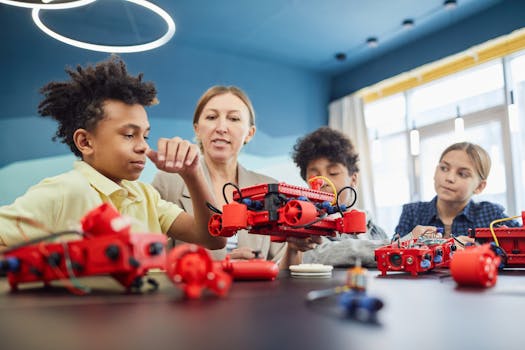
Simple Robotics: With kits like LEGO Mindstorms or Arduino, students can build and program robots to perform various tasks. This is a fantastic introduction to coding, mechanical engineering, and problem-solving loops.
Catapult Creations: Who doesn’t love launching things? Designing and building a catapult to hit a target introduces concepts of physics, leverage, and trajectory.
#### Scientific Explorations: Uncovering Nature’s Secrets
DIY Volcanoes (and beyond!): While the classic baking soda and vinegar volcano is a hit, think bigger. Explore chemical reactions with DIY lava lamps, create crystal gardens, or investigate plant growth under different conditions.
Aerodynamics Experiments: Build and test different paper airplane designs, kites, or even simple gliders. This provides a tangible understanding of lift, drag, and air resistance.
Water Quality Testing: Using simple kits, students can collect local water samples and test for various parameters, fostering an understanding of environmental science and conservation.
#### Technology Tinkering: Coding and Digital Literacy
Scratch Programming: This visual programming language is perfect for beginners. Students can create interactive stories, games, and animations, learning logic, sequencing, and debugging.
Microcontroller Projects: With platforms like micro:bit, students can dive into basic electronics and coding by controlling LEDs, sensors, and motors.
3D Design and Printing: Introduce students to the basics of 3D modeling software and, if resources allow, the exciting world of 3D printing their designs.
Making It Happen: Tips for Success
Implementing successful hands-on STEM projects for middle school isn’t rocket science, but it does require a bit of thoughtful planning.
Keep it Age-Appropriate: Ensure the complexity of the project matches the students’ developmental stage. A challenge that’s too difficult can be discouraging, while one that’s too easy won’t spark enough engagement.
Focus on the Process, Not Just the Product: Emphasize the learning that happens during experimentation, problem-solving, and iteration. Celebrate the effort and the lessons learned from mistakes.
Provide Clear (but Flexible) Guidelines: Offer a clear objective and some constraints, but allow room for student creativity and independent thinking.
Encourage Documentation: Have students keep a project journal to record their ideas, hypotheses, observations, and conclusions. This reinforces scientific methodology and provides a tangible record of their learning.
* Connect to the Real World: Whenever possible, highlight how the concepts and skills being used in the project apply to real-world applications and careers.
Wrapping Up: The Enduring Impact of Doing
Ultimately, hands-on STEM projects for middle school are more than just enjoyable activities; they are powerful engines for fostering lifelong learners, critical thinkers, and future innovators. They democratize STEM, making it accessible and exciting for all students, regardless of their initial aptitude or interest. So, the next time you’re looking for a way to spark curiosity and build essential skills, remember the immense power of getting those hands dirty and those minds engaged. Start small, be enthusiastic, and watch the magic unfold.
Leave a Reply
You must be logged in to post a comment.